
 AICaver
The Doctor Is No Longer First. AI Is Taking Over the Front Door to Healthcare

A year ago, patients were turning ChatGPT into an unofficial medical assistant on their own. In 2026, that behavior became a product: AI can connect to medical records and wearable devices, influence the decision of whether to see a doctor, and in some services already route patients into the real healthcare system. The doctor has not disappeared. But the space in front of the doctor’s door is changing hands fast.
In the summer of 2026, Florida pastor Scott Winters sued OpenAI. According to his lawsuit, he spent several weeks discussing leg pain and other symptoms with ChatGPT, while the system reassured him and did not push him to seek urgent medical care. He was later diagnosed with a severe pulmonary embolism.
I do not yet know whether the court will agree that ChatGPT’s responses played a meaningful role in delaying treatment. That is the plaintiff’s claim, not an established fact. But the existence of the case itself shows how quickly the conversation around medical AI has changed. Not long ago, we were still debating whether a chatbot could even be taken seriously as a medical adviser. Now a court is being asked to decide who is responsible when a person does exactly that.
A year ago, in September 2025, I published an article with the deliberately provocative title “Doctor? Optional.” What interested me then was a strange process: people were taking a general-purpose ChatGPT, which nobody officially sold as a doctor, and assigning it that role themselves. They uploaded lab results, described symptoms, asked about medications, double-checked doctors’ recommendations, and sometimes tried to decide whether they needed to go to a clinic at all.
At the time, I thought that was the big story. For the first time, patients had an almost free conversational partner that was available around the clock, never rushed off to the next patient, and could explain medical things convincingly enough to occupy a space somewhere between Google and a doctor.
A year later, it turned out that was only the first half of the story. Users did not simply keep experimenting. Technology companies started building infrastructure around that behavior.
OpenAI launched a dedicated Health in ChatGPT space. Microsoft created Copilot Health. Google pulled Fitbit, Pixel Watch, and other data sources into a new health ecosystem around Gemini. Amazon connected medical AI to One Medical. UnitedHealthcare began rolling out its own AI navigator to millions of insured members. Epic is adding AI directly inside MyChart, the portal through which patients already communicate with their clinics.
That is why the question “Will AI replace doctors?” now feels slightly outdated to me. A more interesting one is: who will control everything that happens to a person before a doctor even enters the story?
What Looked Like an Experiment a Year Ago Can Now Be Measured
In 2025, the evidence that patients were beginning to use AI as a first stop for health questions was still fairly soft. There were plenty of personal stories, Reddit posts, journalistic experiments, and early surveys, but the line between “I once asked ChatGPT why my knee hurts” and “I changed a medical decision because of an AI response” was still blurry.
Over the past year, that line has become much clearer. Rock Health found that the share of Americans who had ever used an AI chatbot for health information roughly doubled, from 16% to 32%. KFF asked a narrower question about regular use and found a similar direction: the share of U.S. adults using AI for health information at least once a month rose from 17% in 2024 to around 29% by spring 2026.
Those figures should not be added together or compared directly because the methods are different. But both sets of data point to the same thing: talking to AI about health is no longer something only a small group of enthusiasts does.
In July 2026, YouGov found something even more interesting. Eight percent of U.S. adults said AI had been the first source of health information or advice they turned to during the previous three months. Search engines and medical professionals were still ahead, so it is far too early to declare chatbots the winner over doctors. But eight percent is no longer statistical noise.
If a new clinic network became the first source of medical information for one in twelve American adults within a few years, nobody would call it an experiment. AI still gets a strange discount on seriousness simply because it looks like a chat window.
The most important numbers, though, begin where information search ends. Pew found that around 15% of U.S. adults had used a chatbot to decide whether they needed to see a doctor at all.
West Health–Gallup asked the question even more directly. Among recent users of health AI, 14% said the information they received led them not to see a healthcare professional when they otherwise would have. The researchers estimated that group at roughly 14 million American adults.
In the United Kingdom, a King’s College London study found a strikingly similar pattern: 15% of adults said they had used AI health advice instead of contacting a GP or another NHS service.
That does not mean one in six patients has fired their doctor and kept ChatGPT instead. In the same West Health–Gallup study, 84% of recent health-AI users still interacted with the professional healthcare system.
So the dominant model is not “AI instead of a doctor.” It is closer to AI appearing before the doctor, around the doctor, and after the doctor, while full substitution remains a minority behavior. But even that minority is already large enough for healthcare systems to stop ignoring it.
The doctor has not become optional. But AI is increasingly influencing whether a doctor enters the story at all.
Why Patients Go to AI Instead of Simply Booking a Doctor
From the outside, it is easy to dismiss medical chatbot use as simple carelessness. People want quick answers, do not understand the technology’s limitations, and choose a convenient machine over the boring responsibility of seeing a professional.
The surveys tell a less amusing story. People do value speed, but that is far from the whole explanation.
In the West Health–Gallup study, major reasons included getting help outside normal office hours, gathering additional information, and not having to wait. But right next to those reasons were much more practical ones: seeing a doctor was too expensive for some people, others did not have the time, some could not get an appointment quickly, and others had previously felt that a doctor was not listening to them or taking their problem seriously.
KFF found a similar pattern, with cost and access barriers especially visible among younger and lower-income users. That matters because it changes the causal story.
AI is not growing only because it is impressive. It is also growing because traditional healthcare leaves a lot of empty space: evenings, nights, the days between appointments, specialist waiting lists, and the period after a short consultation when a patient has heard the diagnosis but has not really understood it.
If someone receives lab results in an app and sees a red arrow next to a value they do not recognize, “just discuss it with your doctor” sounds perfectly reasonable in a system where the doctor is available tomorrow morning. In a system where the next appointment is three weeks away, the incentives are very different.
The chatbot has an almost unfair advantage here. It does not rush, does not look annoyed, does not say the appointment is over, and lets you ask for the same thing to be explained a sixth time in even simpler words.
Sometimes that is exactly what a person needs: not a diagnosis, just a proper explanation. But the better AI becomes at handling those harmless needs, the more natural the next question becomes. Not “What does this number mean?” but “What should I do now?”
That is where the level of risk changes.
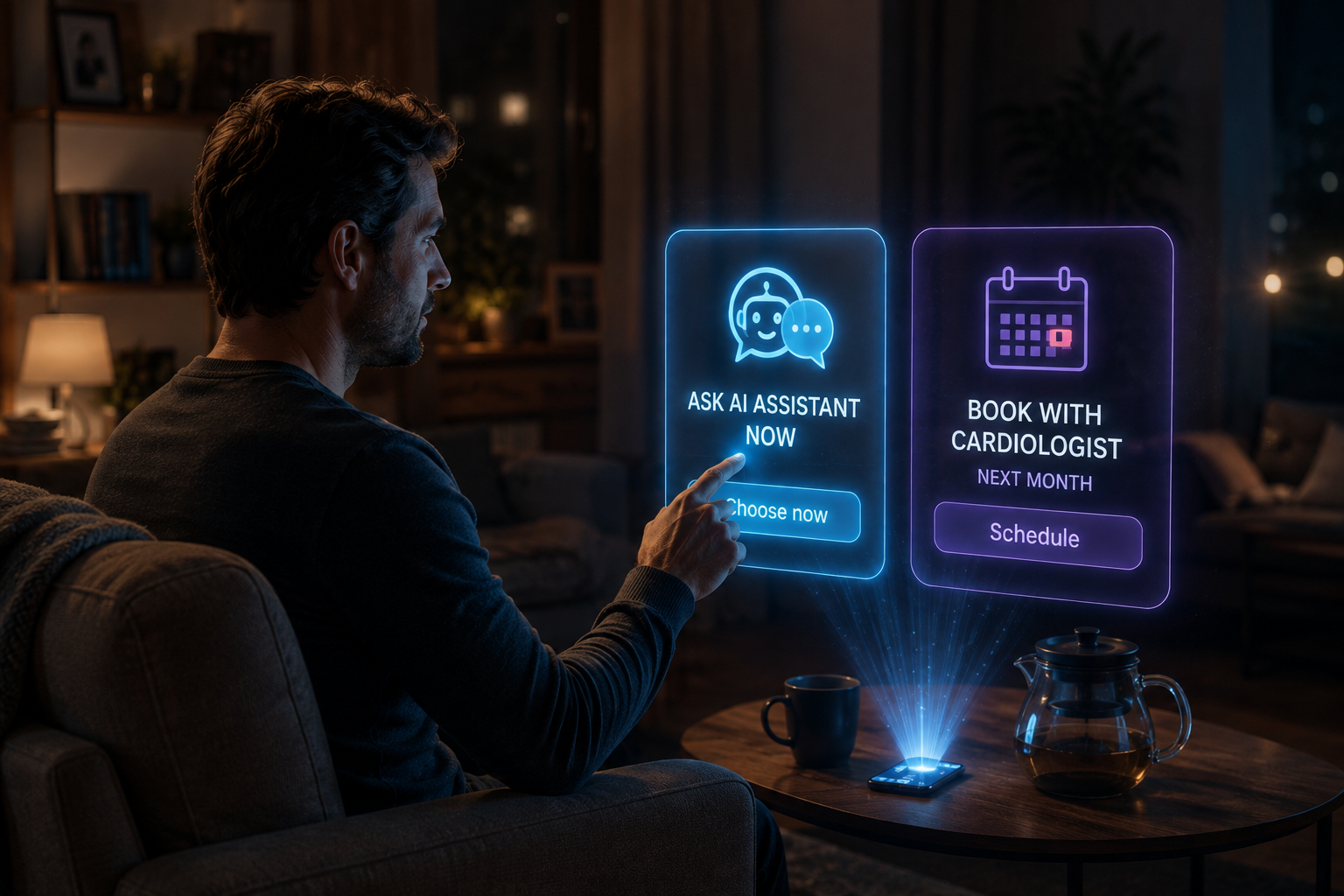 AI does not have to replace the doctor to become the first choice. Sometimes being available now is enough.
There Is Almost No Space Left Between an Answer and an Action
Rock Health asked users not only about their conversations with AI, but also about what happened afterward. Eighty-one percent of people who had used AI for health said they took some kind of action after the interaction.
Most of it was not dramatic. Forty-two percent looked for more information, and 40% contacted a healthcare professional. That, by the way, is a useful counterpoint to the apocalyptic idea that chatbots simply pull people away from doctors. Sometimes AI does the opposite and pushes people toward real medical care.
But then the numbers become more interesting. Thirty-two percent reported changing a health-related behavior, while 18% said they changed how they used medication.
It is important not to write a more dramatic story than the researchers did. That 18% does not automatically mean people secretly stopped taking prescribed drugs after talking to ChatGPT. The study does not establish that.
Still, the fact itself matters. AI is now close enough to real medical life that after receiving an answer, people change how they use medication. That is a fundamentally different level of influence from a conventional encyclopedia.
The chatbot is becoming part of the decision loop. A person describes a problem, gets an interpretation, and then does something in the physical world: books a doctor, stays home, changes a habit, gets a test, or changes how they take a medication.
This is where the legal line between “we only provide information” and “we influence medical decisions” starts to look much cleaner on paper than it does in real life. For the user, all of it happens in the same conversation window.
The Awkward Part: AI Really Did Get Much Better This Year
It is easy to turn a discussion about medical-AI risk into a familiar story: technology is dangerous, people trust it too much, everyone should go back to their doctor and stop pressing the button.
The problem with that story is that the technology really has made a serious leap forward. Ignoring that would be about as honest as ignoring its mistakes.
The progress is especially visible in Google’s work around AMIE, an experimental medical agent. Early medical models were mostly tested like extremely well-read students: here is a case, here are the symptoms, choose the diagnosis.
Newer systems are gradually moving from exam questions to a process. They ask follow-up questions, retain a patient’s history, work with different types of medical data, and update recommendations as new information appears.
In one 2026 study, AMIE was evaluated in disease-management scenarios spanning three consecutive visits. That is no longer a one-shot “guess the diagnosis” task. It is an attempt to test whether a system can remember earlier decisions, account for how the patient responded, and adjust the plan over time.
Another study moved research AI even closer to real medicine: one hundred real urgent-care patients spoke with AMIE before seeing a doctor. The system collected their history and prepared information for the later consultation. It operated under safety supervision and did not replace the clinician — an important qualification that can easily disappear in a catchy headline.
A video version of AMIE also appeared. In controlled experiments, it could conduct a live consultation and ask a patient to perform certain actions in front of the camera to gather more information about their condition.
So the boundary is genuinely moving. Medical AI is no longer just a machine that answers questions. It is beginning to take on the context, continuity, and structure of a consultation itself.
The future AI doctor already exists in the lab. But the chatbot people trust as a doctor today is not necessarily the same AI.
The Smarter the Medicine Gets, the Stranger a Simple Mistake Looks
Of all the studies I read from 2026, one stood out because ChatGPT Health was not being tested on rare diagnoses or difficult clinical exams.
The researchers wanted to know something much simpler: does the system correctly understand how urgently a person needs medical care?
They prepared 60 clinical scenarios and presented them to the system in different contexts, producing 960 interactions in total. In scenarios that experts classified as emergencies, ChatGPT Health underestimated the urgency in roughly 52% of cases.
That result is especially uncomfortable because it sits next to impressive research on complex medical reasoning. A system can show strong performance on a multi-step clinical problem and still struggle with the question a normal person may care about far more: Can this wait until tomorrow, or do I need to go now?
And the problem was not simply that the AI was too relaxed. In lower-risk scenarios, it could also overstate urgency.
For triage, that is the worst combination. A system that sends almost everyone to the emergency department is safe only on paper and quickly becomes useless. A system that too often reassures people in genuine emergencies becomes dangerous.
The goal is to land in a narrow middle. That is where medicine suddenly turns out to be much harder than an exam.
Patients Bring More Than Symptoms Into the Conversation
In the same study, the researchers changed not the medical facts, but the social context. For example, they added a sentence saying that someone close to the patient did not think the situation was serious.
The symptoms themselves stayed the same, but the AI’s recommendation could become less urgent. The effect was strong enough for the researchers to call it out separately.
To me, this is one of the most important details in the entire story of consumer medical AI, because real patients never look like perfectly written clinical vignettes.
People arrive with an explanation already in mind: “It’s probably stress,” “I just pulled a muscle,” “This has happened before.” Sometimes they also arrive with the answer they want: “Tell me I don’t need to go to the hospital.”
A good doctor can notice that and, when necessary, break the patient’s comfortable story. They can listen, understand the fear, and still say: no, we are not discussing how inconvenient it is for you to go to the hospital right now. You are going.
Conversational AI has the opposite kind of vulnerability. It has been trained for years to understand the user, take context into account, be helpful, keep the conversation natural, and avoid sounding like a cold instruction sheet. In most tasks, that makes the product better.
In medicine, the same mechanism can become a weakness. A useful conversational partner also needs to know when to stop being pleasant.
AI can know medicine and still struggle with its most human part: noticing that a frightened person is leaving something out, asking the uncomfortable question, and saying at the right moment, “No. You’re going to the hospital now.”
The Problem Is Not Whether You Trust AI. It Is What Exactly You Trust It to Do
Imagine three questions. What does elevated LDL mean? Can I take these two drugs together? Can this chest pain wait until morning?
From the interface, there is almost no difference between them. The same chat, the same calm tone, the same ability to explain difficult things in simple language.
But the evidence behind those tasks is very different. AI can already be genuinely useful for explaining a term or translating a medical note into plain language. Changing medication on your own or deciding whether an emergency can wait is a very different level of risk.
We are used to trusting a professional as a whole. If I trust a cardiologist, I trust not only their memory for medical facts, but also their ability to recognize when a problem is outside their competence, know which question needs to be asked, and understand when a patient needs to be sent somewhere else urgently.
With AI, it is more useful to think differently. Not “Do I trust ChatGPT in medicine?” but “Which medical function am I handing over to it right now?”
For some functions, the evidence already looks fairly strong. For others, it is promising but still experimental. And for some of the highest-risk decisions, use appears to be moving faster than proof of safety.
The user does not see a special indicator that changes with the type of question. The interface answers confidently both when asked about cholesterol and when asked about a possible emergency.
The same AI can be an excellent translator of medical language and a poor emergency dispatcher. The problem is that the user sees the same confident interface.
Users Did Not Wait for Scientists to Finish the Debate
While researchers are still trying to define the safe boundary, people are already uploading their own medical data into AI systems.
According to KFF, around 41% of health-AI users said they had shared personal medical information with these services. Among younger adults, the practice is even more common.
A year ago, you usually had to copy lab results manually or retell your medical history. In 2026, companies started removing that friction too.
This is the point where medical AI stops being just a medical use case for an ordinary chatbot. It starts becoming a product category of its own.
Users Invented the Workflow. Companies Built an Interface Around It
Health in ChatGPT shows the difference between 2025 and 2026 particularly well. Before, the user had to create the context every time: explain the diagnosis, list medications, paste in lab results, and hope nothing important had been forgotten.
Now there is a separate space for health that can work with connected medical records, Apple Health, and other data sources. Medical context can live longer than one isolated conversation.
Microsoft is building Copilot Health around a similar idea. A user can bring data from healthcare organizations, test results, and wearable devices into one profile, then use AI to explain that information and help find specialists.
Anthropic has also added health-data connectors to Claude. These implementations differ in maturity and availability, but the direction is strikingly similar: the chatbot no longer waits for the user to manually carry the context into the conversation. The product tries to connect to the context itself.
Google is making a somewhat different bet. Beyond conversation, it has a huge ecosystem of continuously generated data: Fitbit, Pixel Watch, sleep, heart rate, activity, workouts, Health Connect.
That is a fundamentally different kind of memory. ChatGPT primarily knows what a person chooses to tell it. Google can potentially sit next to a stream of data the body produces every day, even when the user is not asking anything.
This is where it becomes clear that the race in medical AI is not simply a contest over who can produce the best diagnosis. Different companies have different points of leverage.
OpenAI knows the conversation. Google knows the sensors. Epic knows the medical record. The insurer knows the cost and the provider network. Amazon knows where to sell the next healthcare step.
The smartest model may turn out to be only one component of the system.
 The chatbot is becoming a healthcare interface, connecting conversations with records, wearables, labs, insurers, clinicians, and medication.
Amazon Was the First to Show Why Medical AI Needs a Door
Amazon Health AI is especially revealing. The company did something most general-purpose AI platforms still do not do: it connected the conversation not just to information, but to its own healthcare delivery system.
Amazon already has One Medical, Amazon Pharmacy, payment infrastructure, and a huge consumer audience. That means a medical conversation can continue beyond the chat window.
If a user needs professional care, the system can route them into One Medical — to message a healthcare professional, have a video visit, or book an in-person consultation. The same ecosystem also includes a pharmacy and prescription workflows.
AI does not replace the doctor here. It becomes the corridor to the doctor.
And suddenly the business model makes sense. Amazon does not necessarily need to charge for the medical-AI conversation itself if that conversation can bring someone into a paid medical service, a One Medical membership, or a pharmacy transaction.
The company has already said that its virtual medical visits grew significantly year over year and that a large share of those interactions now begin through Health AI. This is a company-reported metric, so it does not prove that AI itself caused the entire increase.
But the fact still matters. For the first time, we are seeing not just millions of medical questions, but AI functioning as a real entry channel into healthcare services.
The real economics of medical AI may not be in selling answers. It begins where an answer changes the patient’s next step.
The Insurer Wants the Same Door for a Different Reason
UnitedHealthcare is building its Avery assistant around a completely different part of the healthcare journey. It is not trying to be the best diagnostician. Its strength is knowing the insurance coverage, the cost, the network of healthcare organizations, and the rules of a specific plan.
Avery can answer questions about coverage, help users understand insurance issues, find doctors, and assist with scheduling. At launch, the service covers millions of insured members, and the company plans to expand it further.
That creates another version of the medical-AI future. Imagine someone develops back pain: ChatGPT can explain possible causes, Google may know how their activity changed, Epic can see the actual clinical history, and Amazon can route them to a doctor in its own system.
The insurer knows which doctor is in-network and which treatment path is cheaper.
This is where AI suddenly becomes a question of economic power. The interface through which a person asks “What should I do?” may end up shaping not only the answer, but the next paid step.
Who owns that interface is not just a technical question. It is a question of who gets the power to direct patient flow.
Hospitals Are Not Planning to Hand the Patient Over to a Chatbot Either
If you look only at OpenAI, Google, and Amazon, this story can easily turn into another tale of Big Tech arriving to take a market away from an old industry.
Epic shows that the picture is more interesting.
MyChart is already the digital front door to the healthcare system for a huge number of patients. It contains test results, appointments, prescriptions, messages, and medical history.
Epic is developing its own AI intermediary, Emmie, directly inside that environment. The logic is obvious: if the clinic already knows the patient, why should the patient carry lab results into a third-party chatbot and ask it for an explanation without the full clinical context?
It also turns out that some of the most convincing economics of medical AI may have little to do with diagnosis at all. Epic already reports reductions in certain routine support requests, automated scheduling for thousands of patients, and hundreds of staff hours saved.
For the tech press, that is less exciting than a headline saying “AI beats doctors.” For a clinic operations director, it is the opposite.
If AI can answer a billing question properly, schedule a visit, explain a simple result, and keep a patient from having to call a contact center, it is already creating measurable value. It does not need to become an artificial Dr. House to do that.
Where Is the Money? So Far, Not Where People Usually Look
I was especially interested in whether consumer medical AI had become a standalone business over the past year. It would be convenient to find a clean economic picture: here is the price of the medical assistant, here is the number of paying users, and here is the revenue from those consultations.
That clean picture does not exist yet.
There are prices for broader subscriptions that now include health features. There is One Medical. There are enterprise contracts. There is telemedicine, pharmacy, insurance navigation, and already measurable savings in staff time inside healthcare organizations.
But major technology companies rarely disclose a separate line called “revenue from medical AI.”
Maybe because that revenue is still small. Or maybe because looking for it as a separate line is the wrong way to think about the business.
For OpenAI, health may make the main subscription more valuable and improve retention. For Google, it may tie Gemini more closely to devices and data. For Amazon, it can bring patients into One Medical and Amazon Pharmacy. For an insurer, it can lower support costs and direct people within its own network. For Epic, it can protect MyChart as the patient’s main digital interface.
That is familiar platform logic: the most valuable service is not necessarily the one the user pays for directly. Search engines were free for decades. That did not mean they had no economic value.
Medical Memory Is Very Convenient — Especially If You Own the Platform
There is another effect companies would almost certainly prefer to describe as “personalization.”
If an assistant knows the history of your medical conversations, your lab results, your medications, your wearable data, and your past symptoms, it really does become more useful. You no longer need to explain for the fifteenth time what happened six months ago.
But convenience has another side. The more of your history lives inside one service, the harder it becomes to move to another.
For an ordinary chatbot, switching costs are low. Today you can ask ChatGPT, tomorrow Claude, the day after that Gemini.
With medical context, it is more complicated. You have to reconnect data sources, move history, rebuild habits, explain chronic conditions again, and hope the new system reconstructs the picture correctly.
There is no convincing evidence yet that users are staying on a specific platform en masse because of this. So it would be premature to call medical memory a proven retention barrier.
But as a strategic asset, it looks almost textbook. The same thing that makes the service more personal also raises the cost of switching to a competitor.
Sometimes You Pay for Convenience With Something Other Than Money
In the United States, this introduces a fairly uncomfortable legal detail.
Many people naturally assume that medical information is automatically protected by HIPAA wherever it goes. That is not how HIPAA works.
HIPAA regulates specific participants in the healthcare system and the relationships between them. If the data is held by a doctor, a health plan, or another regulated entity, the corresponding rules apply.
If a person moves their own records into an ordinary consumer AI service, HIPAA does not automatically follow that copy of the file. The service may have strong privacy rules of its own, and FTC rules and state laws may apply, but the legal framework is different.
Europe is different: health data is treated as a special category of personal data under GDPR and does not lose that status simply because a user has given it to a technology company.
This is an especially important change in 2026. A chatbot used to know mostly the medical history a person chose to tell it. Now products increasingly want to connect directly to the source of that history.
That creates a new kind of record alongside the traditional medical chart — unofficial, conversational, assembled by a technology platform. For the patient, it may even become more convenient than the official one.
For the company, it is certainly not worthless.
And Then the Courts Arrive
In 2026, the abstract conversation about responsibility began turning into real litigation.
In Scott Winters’s case, the plaintiff claims that ChatGPT falsely reassured him about potentially dangerous symptoms. In another lawsuit, the parents of 19-year-old Samuel Nelson claim that ChatGPT gave dangerous advice about using multiple substances before his fatal overdose.
Both cases are still exactly that: lawsuits. This distinction matters. The existence of a legal complaint does not prove causation or establish OpenAI’s legal responsibility.
But the cases are already important because they force courts to answer a question that recently sounded almost academic. What is a chatbot in this situation: a publisher of information, a software product, an adviser, a tool? And how foreseeable was it for the developer that a user might treat it like a medical professional?
Pennsylvania took a different route. The state sued Character.AI after one of its bots presented itself as a licensed psychiatrist and supplied a fake medical license number.
That case did not even require a new field of “AI law.” An old medical-licensing statute understood “I am a doctor, here is my license” perfectly well.
Sometimes the future walks into court through a very old door.
 AI can sound confident without seeing the whole clinical picture. In medicine, underestimating urgency can have consequences far beyond the chat window.
So “There Is No Regulation” Is No Longer the Right Description
A year ago, it was tempting to say AI was moving so fast that regulation had been left far behind. Today, the picture is more complicated.
There are laws covering medical devices, professional licensing, medical negligence, product liability, consumer protection, and privacy. In Europe, there is also GDPR, the AI Act, and updated rules around liability for software.
The problem is not that there is no law. The problem is that most of these systems were built around familiar roles: a doctor, a hospital, a medical device, an insurer.
A general-purpose chatbot may formally be none of those things while still influencing the same decision that used to happen inside the healthcare system.
If a system explains what a drug is, the classification is fairly straightforward. If it tells a specific person with specific symptoms that they probably do not need to go to the emergency department, the old categories start to strain.
That is the gray zone regulators are now trying to define.
The FDA Has Seen the Problem. The Solution Is Still Written in Pencil
On August 18, 2026, the FDA released a dedicated discussion paper on the regulation of generative-AI-enabled medical devices.
What matters is not simply that the regulator finally used all the fashionable AI terms. The more interesting part is the logic of the document.
The FDA treats medical responses as a continuum from relatively low-risk information to increasingly action-directing advice. Explaining what a medication is carries one level of risk. Taking a person’s specific condition into account and recommending a dose change carries another.
The paper also addresses patient-facing interfaces, multi-turn conversations, triage, escalation, and agentic systems that may not only recommend actions but perform them.
In other words, the regulator is finally describing almost exactly the path users have already taken on their own: from “Explain this term to me” to “Tell me what I should do.”
But the FDA paper is still a discussion document. It is not a new binding rule, and it is not final guidance.
So it is no longer fair to say regulators do not understand the problem. It is also not fair to say a new control system is already in place.
Regulators have caught up with medical AI intellectually. Procedurally, they are still running behind it.
The Doctor Is Still the Central Figure
Despite all the growth in medical AI, the data does not show a mass retreat from professional healthcare. On the contrary, most people who use AI for health questions still see real medical professionals too.
West Health–Gallup, for example, found that 84% of recent health-AI users still interacted with a healthcare provider. That is a good picture of how people actually use these tools today: AI more often complements the doctor than fully replaces one.
A person may first discuss symptoms with a chatbot, then arrive at an appointment better prepared, and return to AI afterward to unpack the diagnosis or treatment plan in normal language. Sometimes AI persuades them to seek care; sometimes, as the surveys now show, it influences the decision not to.
So the most realistic pattern today is not “AI instead of a doctor,” but AI → doctor → AI.
And that makes what is happening more interesting than a simple story about replacing a profession. The doctor remains the central professional, but more and more of the understanding, preparation, and follow-up interpretation around healthcare is happening through another interface.
Who Owns the Moment Before the Doctor?
When someone first notices a new symptom, the healthcare system still knows almost nothing about them. They are not yet a patient of a particular clinic, not an appointment on a schedule, and not even an insurance case. They are simply a person who suddenly feels unwell or frightened and is trying to work out how serious it is.
That space used to be shared by Google, medical websites, a doctor you happen to know on a messaging app, relatives, a clinic receptionist, and your own patience. AI is now moving into that space very quickly.
And different companies are entering from different directions. OpenAI controls the conversation. Google controls the stream of data from devices. Epic controls the official medical record. UnitedHealthcare controls the insurance economics. Amazon controls the path into healthcare services and pharmacy.
No one owns the entire chain yet. And that may be what makes this moment particularly interesting: a new front door is already emerging, but its owner has not been decided.
A few years from now, the most influential company in medical AI may not be the one whose model is best at diagnosis. It may be the one that shows up first when a person notices a problem, knows enough of their history to give a convincing answer, and controls the next step.
That is why I would no longer ask whether the doctor will become optional.
The doctor remains. But increasingly, the doctor is no longer first.
The experiment became infrastructure before it became clinically proven practice.
A year ago, users built a small improvised doorway into healthcare out of a general-purpose chatbot. In 2026, large companies saw how many people were walking through it and started building a real doorframe around it: medical records, watches, labs, insurance networks, clinics, and payments.
The main question is no longer whether AI will someday learn to be a doctor.
The main question is who will meet the person before the doctor — and decide which door they walk through next.
Possible Scenarios for 2026–2027
I do not think the next year will bring mass replacement of doctors by AI. Something else is much more likely: medical AI will continue occupying the space around professional care. More products will connect to medical records, lab data, and wearables, while the conversation itself gradually becomes an ongoing relationship between a person and their digital medical context.
The most serious competition will probably be over the next step after the answer. Amazon is already showing a model in which AI can bring a patient directly into a consultation and a pharmacy. In its first-quarter reporting, the company said virtual medical visits had nearly tripled year over year and that most now flow through Health AI. That is a company-reported metric and does not prove causation by itself, but it does show the direction the product is moving.
That is why I expect the question “Which medical chatbot gives better answers?” to matter less and less in 2027. What happens after the answer will matter more: can the system find a doctor, account for insurance, transfer the medical context, schedule a visit, order a test, or continue monitoring? The competitors here will not be only OpenAI, Google, and Microsoft, but insurers, hospital platforms, telemedicine providers, and pharmacy ecosystems.
At the same time, the gap will almost certainly widen between convenient consumer AI and more constrained systems that can actually be trusted with clinical decisions. Paradoxically, safer medical AI may turn out to be less free-form and less conversational: mandatory follow-up questions, hard escalation thresholds, refusal to answer certain requests, and much more structured workflows. The ChatGPT Health triage study already shows how costly poor calibration can be.
Regulators are also likely to move toward regulating function rather than product labels. In August 2026, the FDA already proposed discussing generative medical-AI risk based on how strongly a system’s output directs patient action. It is still only a discussion paper, but the logic matters: explaining a medication, recommending a dose change, and autonomously arranging the next healthcare step are not the same category of risk.
And finally, medical memory will become a separate battleground. The more health data an AI accumulates — from lab results and medical records to sleep, heart rate, and conversation history — the more useful it becomes and the harder it is to move to another service. Data portability, privacy, and user control may therefore become at least as important in 2027 as the next model release.
To me, that is the most likely scenario for the coming year. AI probably will not become your doctor. But it may very well become the system through which you increasingly understand your doctor, find your doctor, and decide whether you need a doctor at all.
Sources
Rock Health — Consumer Adoption of Digital Health Survey 2025. Survey of 8,000 U.S. adults: use of AI for health questions rose from 16% to 32%; 81% of users took some action after an AI response, 40% contacted a professional, 32% changed behavior, and 18% changed medication use. Rock Health study
KFF Tracking Poll on Health Information and Trust, March 2026. Use of AI for health, reasons for turning to it, the role of cost and healthcare access, and the finding that 41% of users had uploaded personal medical information. KFF study, March 2026
KFF Tracking Poll, June 2026. 29% of U.S. adults use AI for health information at least monthly, up from 17% in June 2024. KFF study, June 2026
YouGov, July 2026. 8% of Americans said AI was the first source they turned to for health information or advice during the previous three months; search engines and professionals still ranked ahead. YouGov study
Pew Research Center, August 2026. 34% of Americans use AI chatbots for at least one of the health tasks studied; 15% use them to decide whether they need to see a doctor. Pew Research Center study
West Health–Gallup Center on Healthcare in America, April 2026. 14% of recent health-AI users said AI advice led them not to see a professional when they otherwise would have; 84% still interacted with professional healthcare. West Health–Gallup study
King’s College London, May 2026. 15% of British adults said they had used AI health advice instead of contacting a GP or another NHS service; among health-AI users, 21% decided not to seek professional care after receiving an AI response. King’s College London study
Nature Medicine — independent evaluation of ChatGPT Health triage. 60 scenarios, 16 context variants, and 960 responses; urgency was underestimated in 51.6% of gold-standard emergency cases, and social minimization cues affected recommendations. Nature Medicine study
Nature — AMIE and longitudinal disease management. Google’s research system was compared with primary-care physicians across 100 scenarios involving three consecutive visits. This was a simulated research setting, not a consumer product. AMIE study in Nature
Google Research — first AMIE study with real patients. One hundred adult patients interacted with the system before a scheduled outpatient visit; conversations were overseen by a physician who could intervene if needed. AMIE study with real patients
Google Research — AMIE Video, August 2026. The experimental system conducted live video consultations, processed audiovisual signals, and guided participants through elements of a remote physical examination. The study used simulated consultations. AMIE Video — Google Research
OpenAI — Health in ChatGPT. Official description of the dedicated health space, medical-record and Apple Health connections, data-use rules, and the launch for adult users in the United States. OpenAI also says more than 300 million people per week turn to ChatGPT with health-related questions. Health in ChatGPT — OpenAI
Microsoft — Copilot Health. Official description of the preview, connections to medical records from more than 50,000 U.S. healthcare organizations, Apple Health, and provider search. Copilot Health — Microsoft
Google — Google Health. Official description of Fitbit’s transition into Google Health and the integration of wearable data, Health Connect, Apple Health, and medical records. Google Health — official Google blog
Anthropic — Claude for Healthcare and personal health integrations. Connections to HealthEx, Function, Apple Health, and Android Health Connect. Claude for Healthcare — Anthropic
Amazon — first-quarter 2026 results. Amazon says Health AI can help arrange care through messaging, schedule appointments, and work with prescriptions; virtual visits nearly tripled year over year, and most now flow through Health AI. Amazon Q1 2026 results
UnitedHealthcare — Avery. Official release: the assistant works with coverage, insurance issues, costs, doctor search, and scheduling; at launch it was available to roughly 6.5 million commercial-plan members and 160,000 Medicare Advantage members, with a plan to expand to 20.5 million people by the end of 2026. Avery — UnitedHealthcare
Epic — Emmie. Official early-deployment metrics include a 58% reduction in billing-related support messages, more than 14,900 appointments rescheduled, and around 750 staff hours saved in one deployment. Emmie — Epic
Scott Winters v. OpenAI, July 2026. The plaintiff alleges that ChatGPT’s medical advice contributed to a delay in seeking treatment before a dangerous pulmonary embolism. These are allegations in a lawsuit, not court-established causation. Winters case — Reuters
Samuel Nelson family lawsuit against OpenAI, May 2026. His parents allege that ChatGPT’s advice about substance use preceded a fatal overdose. Causation remains an allegation in the case. Yale Law School materials on Nelson
Pennsylvania v. Character.AI. The state alleges that an AI bot presented itself as a licensed psychiatrist and used a fake medical license number. Official Pennsylvania announcement
FDA — Generative AI-Enabled Medical Devices, August 2026. The paper discusses risk, premarket evaluation, and postmarket oversight of generative medical-AI systems. The FDA explicitly says it is a discussion paper, not draft or final binding guidance. FDA paper
HHS — HIPAA and apps to which users direct their own health data. HHS explains that once data is sent at the patient’s direction to an app that is not a HIPAA-regulated entity or its business associate, that data is no longer protected by HIPAA rules. HHS guidance
FTC — protecting health data outside HIPAA. The FTC stresses that being outside HIPAA does not mean being unregulated: many health apps remain subject to the FTC Act and the Health Breach Notification Rule. FTC guidance on consumer health data
European Commission — GDPR. Health data is treated as a special category of personal data and receives heightened protection. European Commission guidance on special categories of data